Boil Water Advisory: LOW and HIGH Pressure Districts
Published on September 19, 2026
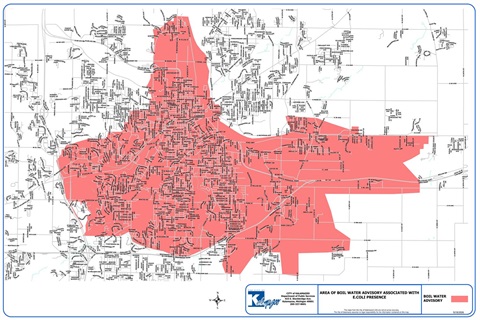
E.coli bacteria were found in one sample on September 18, 2026. When bacteria is detected, three repeat samples are collected. One repeat sample was total coliform-positive but did not contain E. coli. The other two repeat samples did not contain bacteria. Because one sample contained E. coli and a repeat sample was positive for total coliform, a violation occurred. A public notice is required for this violation.
As our customers, you have the right to know what happened and what we are doing to correct this situation. These bacteria can make you sick and are of particular concern for people with weakened immune systems. We are now conducting additional sampling to determine the extent of the problem and a thorough investigation to determine the source of the contamination.
The boil water advisory applies only to persons consuming water within the City of Kalamazoo's Low and High pressure districts (see map).
Municipal water customers within the affected area should not drink the water without boiling it first.
Customers should use bottled water or bring tap water to a rolling boil and boil for at least two minutes before using it for drinking, making ice, preparing food, brushing teeth, washing dishes, or other consumptive purposes.
E. coli are bacteria whose presence indicates that the water may be contaminated with human or animal wastes. Human pathogens in these wastes can cause short-term effects, such as diarrhea, cramps, nausea, headaches, or other symptoms. They may pose a greater health risk for infants, young children, some of the elderly, and people with severely-compromised immune systems.
The City will continue collecting and evaluating water samples and will provide additional information as it becomes available. The drinking water warning will remain in effect until the City determines that the affected water is safe for normal use and the warning can be lifted.
What happened? What is being done?
Further follow up sampling to confirm results and source are being conducted currently. We will inform you when tests show no bacteria and you no longer need to boil your water. We anticipate resolving the problem by 9/22/2026.
For more information and general inquiries, please contact the City of Kalamazoo at 311 or (269) 337-8000 during business hours. General guidelines on ways to lessen the risk of infection by microbes are available from the United States Environmental Protection Agency’s Safe Drinking Water Hotline at 1(800) 426-4791.
For water emergencies, please contact the City of Kalamazoo Water Emergency number at (269) 337-8148
No special precautionary measures are necessary for water used for bathing or showering unless otherwise directed by the City or the Kalamazoo County Health and Community Services Department.
Please share this information with all the other people who drink this water, especially those who may not have received this notice directly (for example, people in apartments, nursing homes, schools, and businesses). You can do this by posting this notice in a public place or distributing copies by hand or mail.
FAQ
What is E. Coli?
E. coli (Escherichia coli) is a group of bacteria that normally live in the intestines of humans and animals. Most strains are harmless, but some can cause illnesses such as diarrhea, urinary tract infections, and foodborne disease.
What is the source or cause of the bacteria?
The source of the bacteria detection is unknown at this time. An assessment will be conducted by EGLE staff to help to determine any potential source and contributing factors. Sources, although unknown at this time, could include sampling errors, sampling interference, external interference at the sample tap, environmental deposit or human touch of the sample tap, stagnation of water in the sample tap, and/or low chlorine residuals within the distribution system can all contribute to bacteria detection. An assessment by EGLE will also help to rule out any infrastructure related concerns.
What are low and high pressure districts and why are those the areas of concern?
The Kalamazoo Public Water Supply is comprised of 11 pressure districts and 13 sources of water supply. The pressure districts are elevation based isolated portions of the system designed to serve customers at uniform pressure. The naming convention of the pressure districts references the base ground elevation in relationship to the hydraulic grade line of the system. The Low Pressure District for example is at the lowest elevation of the system, however the water pressure delivered to customers is the same as all of the other pressure districts at higher elevation gradients.
The Boil Water Advisory includes the pressure district where the initial detection occurred, the Low Pressure District and the immediately adjacent pressure district, the High Pressure District as a precautionary measure.
How does the bacteria problem get resolved?
Distribution sampling locations are being flushed to ensure that the lines are clean and that proper chlorine residuals are maintained. Resampling is occurring to ensure that no bacteria are present.
What are the areas in and around the City of Kalamazoo that contain the presence of E. Coli?
The E. Coli was detected at a single distribution sampling tap of the drinking water system along Miller Road within the Low Pressure District. Subsequent resampling did not detect any E. Coli. No E Coli were detected in any source water of the drinking water system.
The Boil Water Advisory includes the pressure district where the initial detection occurred, the Low Pressure District and the immediately adjacent pressure district, the High Pressure District as a precautionary measure.
Why is this notice important to residents?
The City of Kalamazoo received an E. Coli positive result on Friday (9/18/2026) from a sample collected on Thursday from a distribution monitoring location. The Department of Public Services resampled multiple locations within the distribution system and all sources at multiple locations with results available this morning (Saturday 9/19/2026). The results of the enhanced sampling indicated no detections of E. Coli, however there was one detection from a different distribution location with a positive result for total coliform group bacteria.
The violation notice was due to the single E. Coli detection. The E. Coli detection activated an enhanced sampling plan with results available this morning, Saturday 9/19/2026.
The Boil Water Advisory is due to the detection of the coliform group bacteria detected this morning, Saturday 9/19/2026.
Does the presence of E. Coli pose a risk to the public?
E. Coli can spread from person to person. Common symptoms include abdominal cramps, diarrhea which may be bloody, nausea, and constant fatigue.
Will the City be providing bottled water to residents?
The City will not be providing bottled water to residents via any direct point of distribution. Municipal water customers in the affected area may use individually sourced bottled water for consumptive purposes or boil their tap water for 2 minutes prior to use for drinking or other ingestion.
No special precautionary measures are necessary for water used for personal hygiene.
It is anticipated that the BWA will be lifted by 9-22-2026.
The City states the problem will be resolved by 9.22. Is there a chance this could go on further?
While it is unlikely, any additional positive detections of either E. Coli or total coliform bacteria would result in an extension of the BWA. Please note that there are other ongoing and newly issued BWA(s) due to construction and water infrastructure repairs across the coverage area.
What are the steps that the City of Kalamazoo and the Michigan Department of Environment, Great Lakes and Energy are taking to resolve the situation?
The City of Kalamazoo is in contact with the Michigan Department of Environment, Great Lakes and Energy (EGLE) to monitor the E. Coli presence. One routine sample was E. coli-positive, followed by one repeat total coliform-positive (E. coli-negative). This is an E. coli MCL violation. Distribution sampling locations are being flushed to ensure that the lines are clean and that proper chlorine residuals are maintained. Resampling is occurring to ensure that no bacteria are present.
A tier 1 public notice is required to be distributed within 24-hours and an assessment will be conducted by EGLE staff. The assessment will help to identify additional corrective actions.